

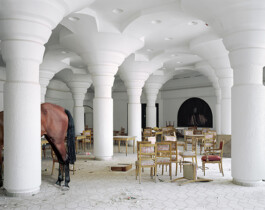
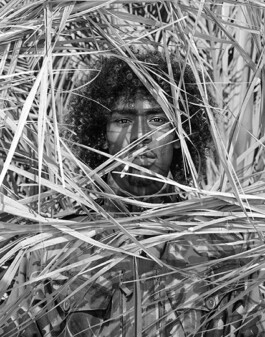
The Arab Spring, a wave of nationwide citizen protests against corruption and social injustice that began in Tunisia in 2010 and spread to much of the Arab world, triggered major social and political upheaval. A year later, the collective call for change reached Libya. The ensuing civil war plunged the country into a state of instability and political division that continues to this day. In his long-term multimedia project Anton’s Hand is Made of Guilt. No Muscle or Bone. He has a Gung-ho Finger and a Grief-stricken Thumb, Edgar Martins documents his six-year search for traces of his friend and colleague South African photojournalist Anton Hammerl, who, in the turmoil of the Libyan civil war in 2011, was murdered by troops affiliated with Muammar al-Qaddafi. The result is a visual archive that brings together a wide variety of evidence and temporalities. From places and people who, as silent witnesses, were potentially able to provide Martins with clues to Hammerl’s whereabouts to fragments of mobile phone photos found in Darknet forums, Martins’s visual reconstruction not only subverts the conventional mechanisms of war reporting but also touches on key issues relating to the portrayal of conflict, loss and trauma.
Website:
The Arab Spring, a wave of nationwide citizen protests against corruption and social injustice that began in Tunisia in 2010 and spread to much of the Arab world, triggered major social and political upheaval. A year later, the collective call for change reached Libya. The ensuing civil war plunged the country into a state of instability and political division that continues to this day. In his long-term multimedia project Anton’s Hand is Made of Guilt. No Muscle or Bone. He has a Gung-ho Finger and a Grief-stricken Thumb, Edgar Martins documents his six-year search for traces of his friend and colleague South African photojournalist Anton Hammerl, who, in the turmoil of the Libyan civil war in 2011, was murdered by troops affiliated with Muammar al-Qaddafi. The result is a visual archive that brings together a wide variety of evidence and temporalities. From places and people who, as silent witnesses, were potentially able to provide Martins with clues to Hammerl’s whereabouts to fragments of mobile phone photos found in Darknet forums, Martins’s visual reconstruction not only subverts the conventional mechanisms of war reporting but also touches on key issues relating to the portrayal of conflict, loss and trauma.
Website:
contact
office@fotodoks.de
Festival address
Architekturgalerie München
Blumenstr. 22
80331 München
The exhibition has finished and is now closed.
contact
office@fotodoks.de
Festival address
Architekturgalerie München
Blumenstr. 22
80331 München
The exhibition has finished and is now closed.